Run Reigate 2026 – on your marks, get set, go!
We’d been gearing up for Run Reigate for months. Our team of 33 runners had




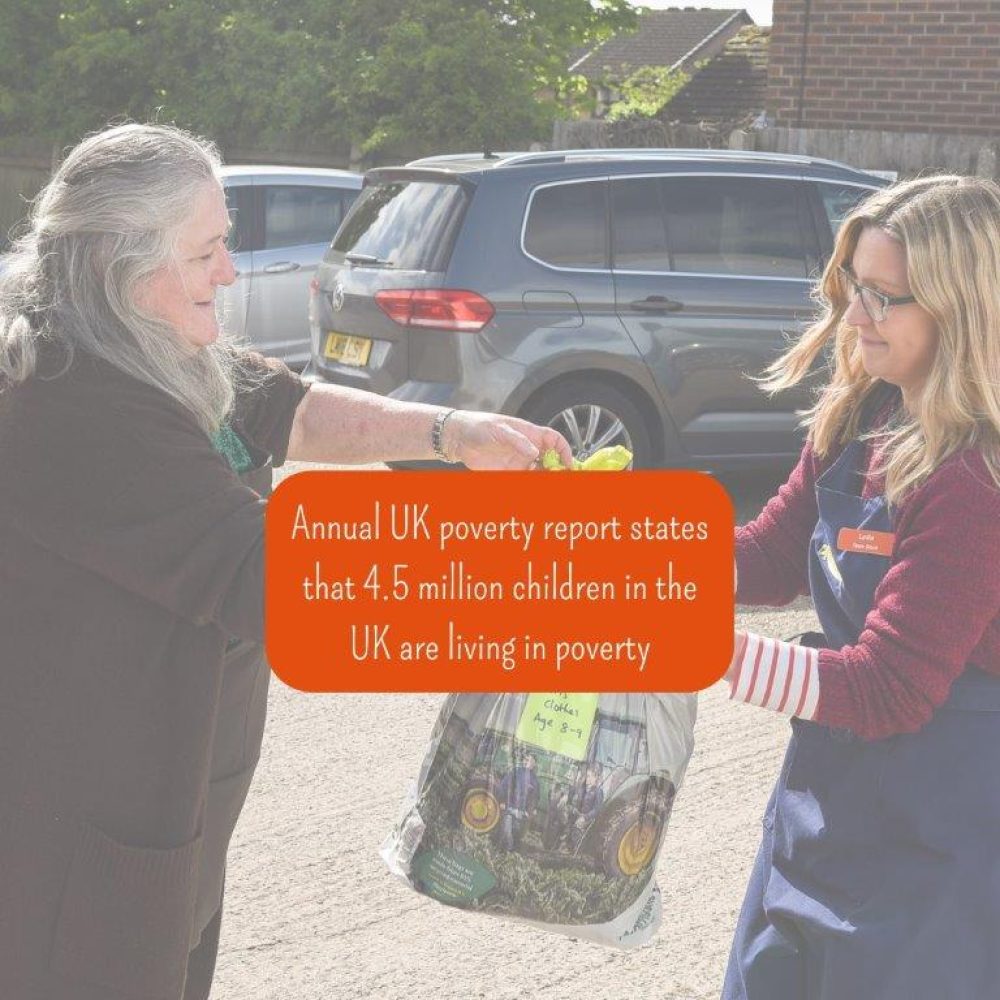
This week, the Joseph Rowntree Foundation released their annual report into poverty in the UK: UK Poverty 2026. The report is based on 2023/4 data, the most recent data available, and it sets out the nature of poverty in the UK and evaluates changes under the last Government. It also sets out the scale of action necessary for the current Government to deliver significant change. For us, as an organisation supporting people in poverty, it is a clear indicator of the continuing need of the community and warns of some possible increases in need in some of the areas we work in.
The report includes regional data, as well as trends around child poverty, and summarises the difficulties faced by children in low-income families in the UK.
The long-term data shows clear differences in how poverty affects different groups. Children have consistently faced the highest poverty rates of any age group, and this gap has widened again in recent years. After falling in the early 2000s, child poverty rose from the early 2010s onwards, dipped briefly during the pandemic, and has since climbed to its highest level in over a decade (31% in 2023/24).
The report also shows that more people than ever are now classed as being in ‘deep poverty’ – meaning their annual household incomes don’t meet the cost of essentials. Or as The Guardian puts it, ‘the poorest families are getting poorer’.
The report describes families with children as being a group facing ‘unacceptably high’ levels of poverty. Children in single parent families, larger families, and those with disabilities are still disproportionately affected, and more families than the previous year are now in ‘deep poverty’, with an income far below the poverty line where they could access a reasonable standard of living. Although recent announcements of changes to the 2 Child Benefit limit are welcome and are expected to have an impact in the future, this will take years – the change is forecast to only reduce the number of children in poverty to 4 million, by around 2030. And with nearly 70% of families referred to us having 1 or 2 children, there will be no change for the majority of the demographic we support.
England still has the highest child poverty rate of all the UK (31%). The South East has an overall poverty rate of 19%, and London of 26%.
Here, we can examine at constituency level the rates of child poverty in any area: https://www.jrf.org.uk/uk-poverty-statistics/geography.
Though this is by no means the only indicator of need, below are some of the child poverty estimated rates for some of the key areas we work in, compared to the report released last year.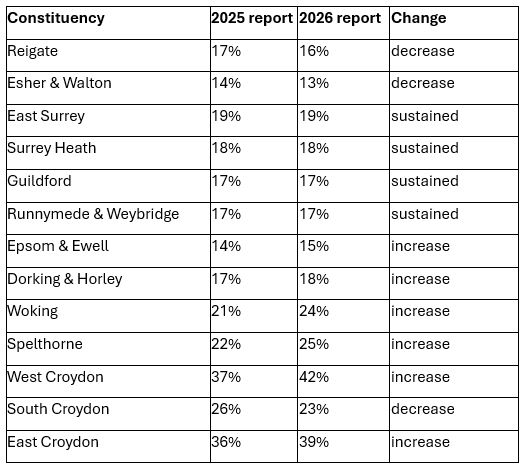
While these numbers are lower than some areas of the country, they are still worryingly high. These seemingly small percentages still represent thousands of children in poverty. For areas that are seen as affluent, where it is possible to achieve a very high standard of living, it can still be difficult to ‘see’ the true picture of life in poverty for those whose standards of living are far lower (and some of the families we help tell us that this stigma can be a barrier to them getting help). Poverty exists everywhere, and in some areas of Surrey (at a more local level than the data above) we see higher levels of deprivation: Surrey data confirms that there are neighbourhoods within the most deprived 20% of England, and a further 22 among the most deprived 30%. Behind the data, are families like this one, with few belongings, moved suddenly to new accommodation, and unable to keep warm.
We know that the need for our service remains significant, and the data just reinforces the attention we’re paying to delivering more in areas like Spelthorne and Woking. In Croydon, where we have been focusing our efforts on increasing provision, we can see there are real increases in need that mean we must continue to do what we can as a service to connect and provide there.
With the cost of living, lack of affordable housing, childcare and other significant financial challenges still ongoing, we know that our service will continue to be a lifeline for families and the partners who support them. We also remember that there are many families who may not – on paper – meet the definition of poverty that data like this report examines, but still face hardship. Some for a short time, some for the long term, and as we are here for them now, so we want to be there for every family who will need us over the coming years.
Your support is invaluable in helping us to do that. You can help by donating your pre-loved items, making a financial donation or fundraising for us. Every donation makes a real difference to a family.